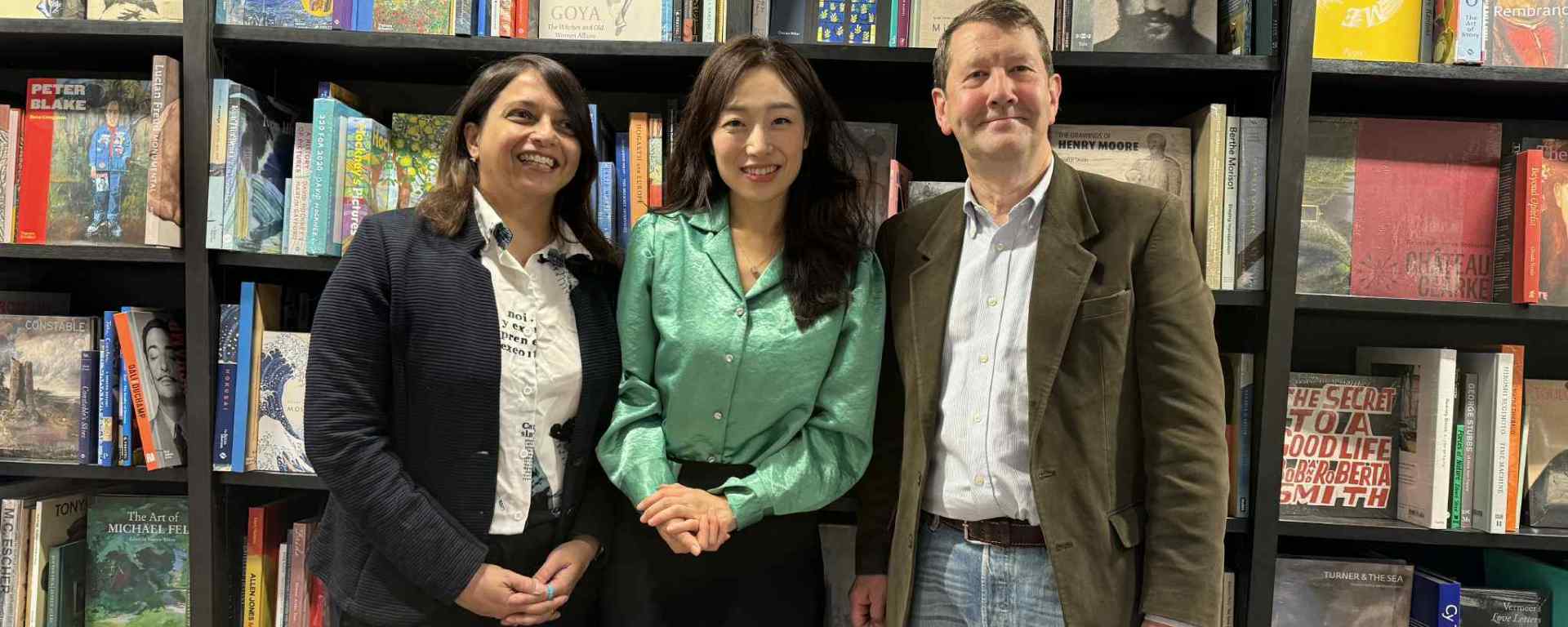
Yun Ko-eun’s stories are intense, atmospheric, and at times almost illogical — yet always compelling. In person, however, she is calm and warm; she laughs easily, and I find myself laughing with her in a small café near Covent Garden, sipping the hot Earl Grey tea she has kindly bought for me. I am not sure whether it is nerves or simply her presence, but the laughter comes naturally. I pause for a moment and consider how we have arrived here.
A few months earlier, on Instagram, I had received a new follower notification and was pleasantly astonished to find it was Yun herself — even more so when she messaged to say she would be speaking at Waterstones Covent Garden and hoped I might come. We had met once before, at the Korean Cultural Centre, when she was in London to discuss her first translated novel, The Disaster Tourist (translated by Lizzie Buehler), which won the 2021 CWA Crime Fiction in Translation Dagger. I am genuinely moved that she has remembered me with such warmth.
Yun became a writer shortly after university and has published nine works in Korean to date, winning several awards that recognise her innovative style of writing. The Disaster Tourist, in particular, has reached a broad international readership and has been translated into more than ten languages. Three of her works have been translated into English, along with a short story titled ‘The Chef’s Nail’, which was published online and translated by Charles LaShure. The current three books, however, are translated by Lizzie Buehler. Their paths first crossed when Buehler reached out to Yun, wanting to translate Table for One for her university dissertation. Yun says that she and Buehler share a similar understanding of humour and fear. I note that this is crucial in a translator–author relationship: the translator needs to truly understand the writer’s voice in order to render it clearly in another language. Yun compares translation to adaptation. The Korean and English versions of a book, she explains, are never identical; they are like a novel and its film counterpart — the same story seen through a different medium, a different breath.
I find myself wholly absorbed by Table for One, sentence by sentence. The stories take place in a world that is recognisable and yet slightly skewed. ‘Sweet Escape’, where a man becomes obsessed with bedbugs, borders on the absurd, yet it is comical in a way that is quietly unsettling.

The cover of the English edition shows a pensive zebra sitting alone at a table, delicately holding chopsticks in one hoof while eating cup noodles. It is both ridiculous and strangely moving. When I ask why a zebra, Yun explains that her editor suggested it, and she notes that the Korean edition from 2010 carries the same cover. The image mirrors the world of these stories: lonely, bizarre, humorous, and sincere. She mentions that she once found a small zebra figurine in a market; it now sits behind her on video calls, watching quietly, as though it has stepped out of the book and stayed with her.
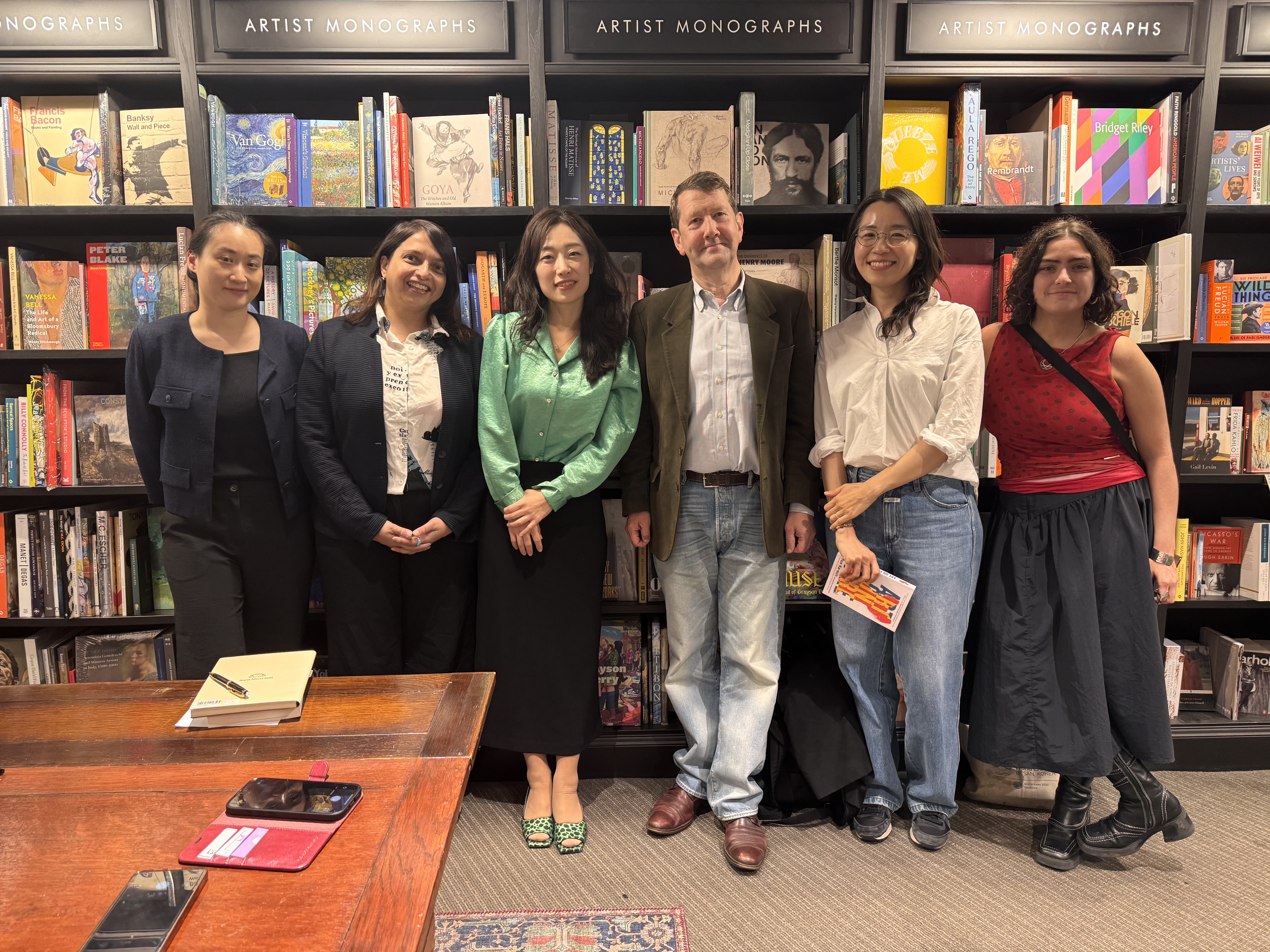
I am interviewing her together with fellow literature enthusiast Philip Gowman, with an interpreter, Sophia Dasol, present, and we take turns asking questions in the short window before the event. Yun is in London to speak about her newly translated novel Art on Fire; as I have not yet read it, our conversation focuses mainly on the works we know well: The Disaster Tourist and Table for One. We do not manage to get through all of our questions in the time, so we continue the conversation after the event by email. We are curious about many things, but especially about where her ideas come from.
The ideas come in ordinary, passing moments: waiting for the green man to change at a pedestrian crossing, shampooing her hair, talking with friends, or simply sitting in a café facing a wall. These small pauses are when things in her mind begin to mix together — when the familiar shifts slightly — and this, she says, is when the ideas take flight.
At the event that evening, she mentions that she often observes pedestrian crossings in different cities — the rhythm of the lights, the length of the pause. In London, she notes, the green man appears and disappears almost too quickly, barely leaving enough time to cross, let alone to think. I realise then that if she lived here, those small pockets of suspended time — where ideas quietly gather — might simply vanish. I wonder what kind of Yun Ko-eun stories would manifest then.
She laughs when asked if she is a bit crazy for the way ideas come; perhaps there is “a little madness” in it, she says. As a child, she suffered from very poor eyesight and often mistook shapes from a distance. I, too, have had poor eyesight since childhood and feel closer to her in this moment. While riding in a car, she would sometimes see faces in trees — sometimes humorous, sometimes eerie. Without hesitation, she picks up a pen and sketches a small scene on the back of our question sheet: a crossroads, a row of trees with faces, and a lone figure at the edge. Philip jokes that we should frame it; Yun smiles and suggests perhaps we should set it on fire.
This connects directly to her newly translated work. Later at the event, she explains that she is drawn to the tension that occurs when two things that do not seem to belong together are placed side by side. ‘I like it when two completely unrelated things sit next to each other,’ she says. In The Disaster Tourist, the pairing of ‘disaster’ and ‘tourism’ feels both incompatible and entirely plausible. In Art on Fire, we think of art as something to be preserved, and yet the central work is burned — something with a limited life. The point is not shock, but the friction that emerges when the expected and the unexpected are allowed to coexist.
When asked whether she prefers writing short stories or novels, she laughs. It depends on which one she is promoting, she says — practicality first. If she had to choose, the longer form is harder. A novel is like riding a wave that keeps rising: you have to stay with it, even when it becomes exhausting. A short story, on the other hand, is more like tearing a sheet of paper cleanly in half and deciding that is where it ends. There is a freedom in that. But not everyone appreciates the open ending. ‘Some readers especially want everything sealed,’ she says. ‘They want the Lock & Lock container version of a story. Married or not. Alive or dead. No loose edges.’ The short form lets her refuse that. The novel does not. However, Art on Fire is itself an open-ended novel — one with an ending that can be interpreted in more than one way. It is not a Lock & Lock container.

My mind later returns to ‘The Chef’s Nail’, which I have just finished reading, with its bizarre ending of books flying upwards into the sky. It is a short story — and it can remain ambiguous.
It is this line between reality and absurdity that draws me to Yun’s work — the place where fear and humour hover together. She describes her characters as living in a state of perpetual comparison: person against person, art against art, disaster against disaster. ‘The starting point of this loneliness is the gaze of others,’ she later writes to me. ‘My characters plunge into endless competition, not to live at their own pace, but to avoid falling behind. One small mistake, and their entire lives can be ruined.’ The collapse is immediate, disproportionate, and recognisable. It is not exaggeration, but a reflection of how easily a life can be tilted by pressure.
What strikes me is how grounded the emotions are. The stories may shift into the absurd, but the feelings remain recognisable. The situations bend, but the emotional logic stays real. It reminds me that a writer does not need to place themselves directly into a character to be present in the work; their way of seeing the world is already there. Reality comes first, and then the slight tilt.
What keeps her writing, she says, is the desire to invent. Her stories ‘hover in mid-air, or perhaps they are grounded, attempting just the slightest jump — enough to be confusing.’ It is not fantasy, but reality adjusted by half a degree: artists funded by dogs; academies that teach you how to eat alone; part-time jobs reading books on the subway; marriage insurance; South Koreans investing in North Korean flats. Unusual, but not impossible. ‘What matters most is satire,’ she says. She relishes mocking reality — not to escape it, but to show how tightly it already constrains us.
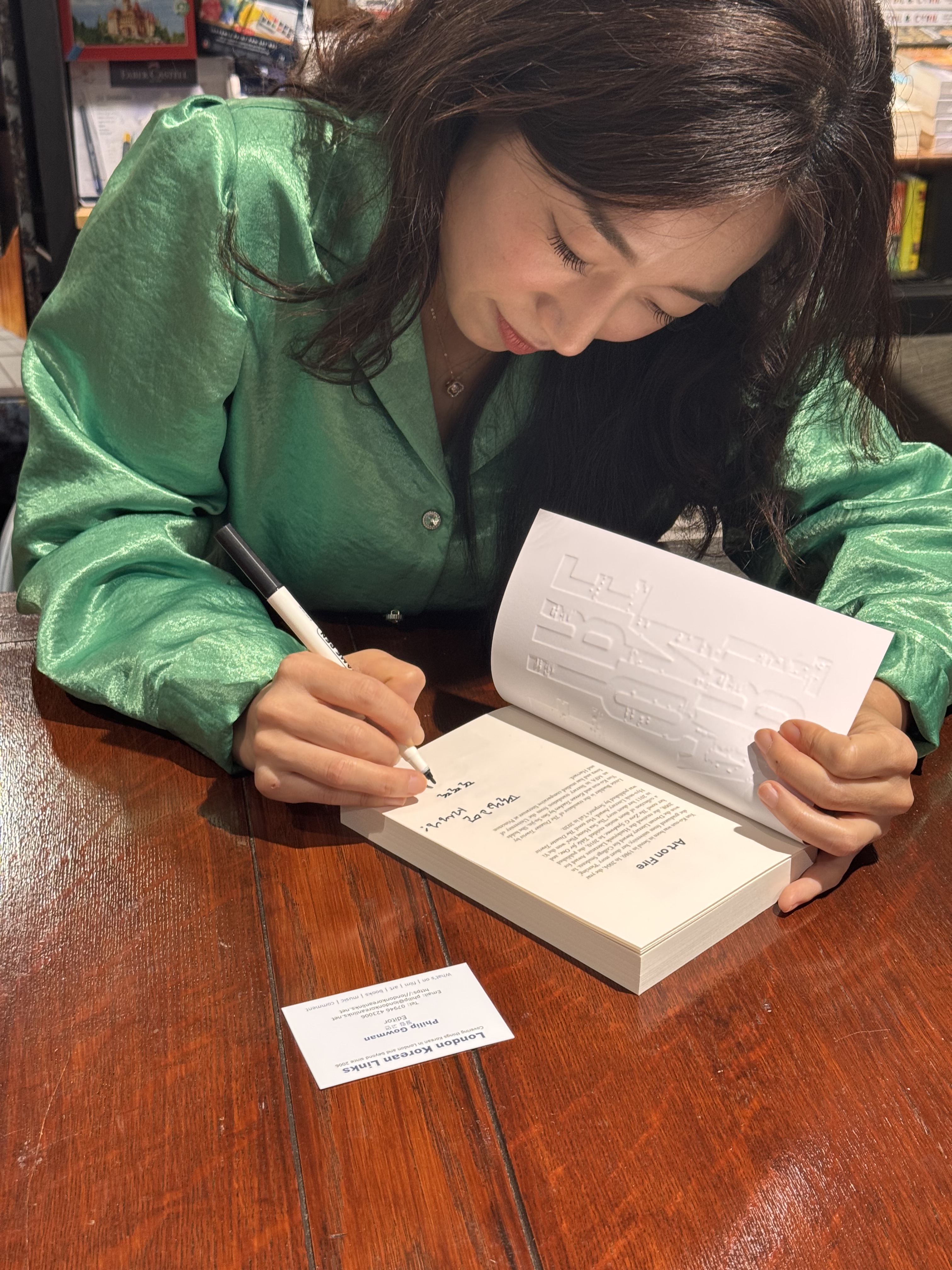
In all my interviews, I like to ask what a person’s chosen superpower would be, as the answer often offers a small but telling insight. She answers: ‘Teleportation. If teleportation were possible, I could have a little more time.’
With the growing number of newly translated Korean works now filling what little space remains on my bookshelves, I am looking forward to reading Art on Fire next — a novel about, among other things, a dog who owns a house and may use his own faeces to create artwork. During the event, Yun spoke about the unexpected amount of research that went into writing it, and I admire the dedication behind that work. It feels like the same blend of uncanny humour and quiet intensity that runs through her stories — and, I realise, through her as a person too.
I leave the event thinking — should I frame her little sketch, or set it on fire…?
All images taken by Diya Mitra
 Diya on Korea