
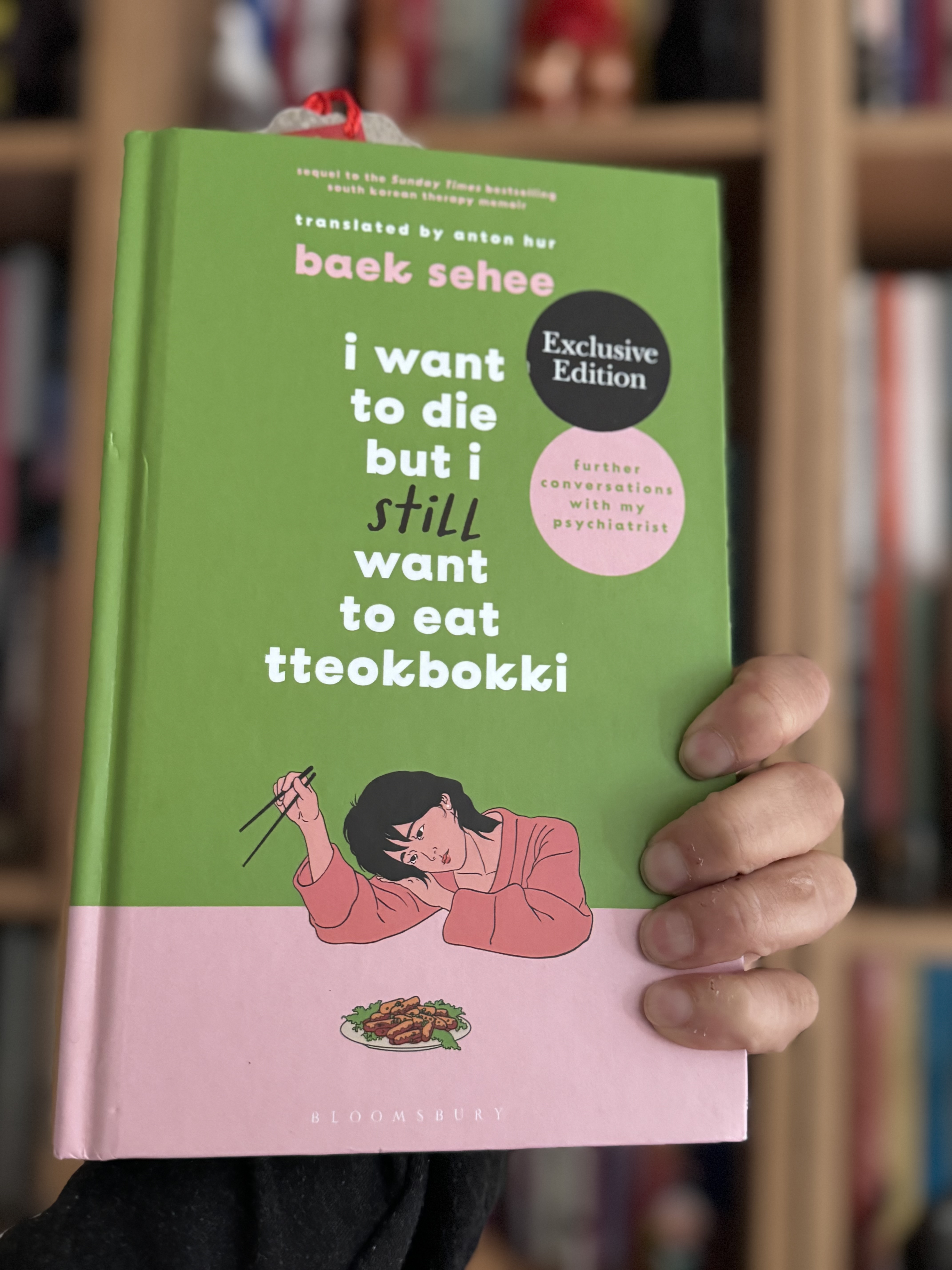
Author: Baek Sehee
Translator: Anton Hur
Publisher: Bloomsbury
This is the follow up to Baek Seehe’s bestseller ‘I Want to Die, but I Still Want to Eat Tteokbokki.’ This has also been translated by superb translator Antor Hur. Is there anything he cannot do? He recently released his own novel and I am hoping to purchase it and add it to my book list.
For this sequel, I love how Baek addresses the English readers of the edition, by starting off: ‘When reading this book, you may feel embarrassment, shame or judgement, as if you are reading a diary entry of your own.’
It immediately warns you that the following content may make you feel awkward. Baek asks the readers to stop and a take moment and reminds them that these are someone else’s feelings and to separate them from their own.
Being uncomfortable is something I felt quite a lot when reading her first book. It is the raw vulnerability of which Baek presents herself assuring us that although you can recover from this mild form of depression – dysthymia – one is never completely cured and there is always work to be done on yourself.
In the chapter ‘Seeing myself through the eyes of others.’ Baek writes about how she is very interested in other people; but is sad when similar feelings are not reciprocated. She notices when people wear beautiful clothes or get haircuts and this resonated with me. As I weirdly always notice when people have done something different to their hair. I laughingly say it’s a skill I should put on my CV. I do mention it to all genders, but wonder if they think that by me noticing, they think I might like them or something!I once had an acquaintance from the gym quickly reference his wife when I asked if he had a haircut 😂. “My wife did not notice, but you did!”
Throughout the course of the book, Baek goes through quite a journey; and is more in-depth with her feelings than the first one.
She is desperate to quit her job, yet her psychiatrist is telling her to make the decision when she feels slightly better, rather than from a place where she is not stable. However, I feel it can be challenging to make such decisions and maybe one sees clearer and with more stability after the decision has been made.
Towards the end of the book, we see Baek managing her emotions a little better. She reflects on feelings of emptiness but realises that not all feelings can be filled all the time and she is having to live with her scars.
There was a time she was wanting to be anyone but herself; and I remember going through similar feelings growing up.
I enjoyed this account more than I did the first one and took pleasure and comfort in reading this in a busy environment. I was on the tube when I had an encounter with a fellow passenger, a woman in her early twenties, who politely interrupted me to ask me how I was finding the book. I told her it was interesting and I much enjoyed the first one. I mentioned that the second book had more suggestive solutions, which is something Anton had commented upon in his Instagram channel.
I would definitely recommend reading this – but I would start with the first installment to truly get that breadth of understanding of Baek’s account.
*Tteokbokki is a popular snack in Korea. Made up of Sticky shaped rice cakes and eggs and fish cakes in a spicy sweetish sauce.
‘I Want to Die but I Still Want to Eat Tteokbokki’ by Baek Sehee and translated by Anton Hur, available to buy from all good book shops and online platforms. Published by Bloomsbury
 Diya on Korea